
Nighthawks Review: Vampire RPG's Brilliant Moments Overshadowed by Uneven Design
The Curiosity Engine's narrative-driven vampire RPG shows flashes of brilliance in its city vignettes but struggles with pacing, progression systems that undermine choice, and a scattered overall structure that never quite coheres.

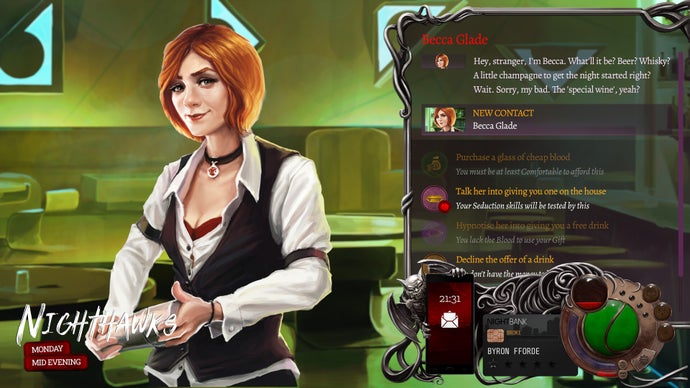
Nighthawks, the 2026 vampire RPG from The Curiosity Engine and published by Wadjet Eye Games, takes its name and thematic inspiration from Edward Hopper's 1942 painting. Like the canvas depicting connection amid isolation, the game attempts to tell stories of intimacy in a cold urban landscape. When it succeeds, those moments linger. When it falters, the cracks in its structure become impossible to ignore.
You play a newly-made vampire who rapidly ascends to prominence by taking over the titular Nighthawks nightclub in a city divided into three neighbourhoods: the down-and-out Cradlebridge, the red light district Angelbreach, and the upper class Fountaincourt. Each evening you explore these areas, solving narrative vignettes using levelable traits like brawling and seduction, alongside special skills unique to your vampire nature. The game organises its story across five acts, each spanning a single month.
The game's strengths emerge clearly in specific vignettes that use its vampire premise to examine real social problems. Two standout quests involve freeing women from restrictive circumstances, and they work because they weave ancient themes into Nighthawks' specific setting. One centres on a centuries-old vampire unable to escape historical cultural constraints that remain relevant today. The other explores daywalker and vampire relations in a world where the supernatural has only recently been revealed. These moments feel earned and thematically precise.
Yet these strong quests also highlight Nighthawks' fundamental problem: they succeed by taking established oppression and making it interesting through the game's vampire twist. The broader anti-vampire sentiment that threads through the main arc lacks that same impact. Human supremacist groups roam the streets and can randomly attack you, but the threat never feels convincing. You become powerful quickly enough that these encounters cease to matter narratively or mechanically. The game struggles with a common pitfall of narratives centred on oppressed groups: vampires are genuinely dangerous, which complicates any straightforward sympathy.
Pacing issues undermine the narrative from the outset. The first act drags because the game depends on companions and secondary characters for meaningful moments but provides little motivation for why they travel with you. Almost every companion agrees to join immediately, yet their personal problems and reasons for being present remain obscure. Veronica, who explicitly asks you to show her the city and push her boundaries, becomes an exception that proves the rule. She ends up with one of those excellent personal quests.
A deeper problem stems from the game's structure itself. With only nighttime hours available each month and no real time pressure, you'll frequently find yourself with nothing to do but wait for the next story beat. The game offers no penalty for failure and no reward for efficiency. This removes friction, strategy, and consequential choice. You might as well pursue every quest and every feeding opportunity, fund every social program, because you have the resources and time for everything without serious trade-offs.
The RPG systems amplify these issues. It's rarely possible to lock yourself out of an outcome through skill deficiency. Early lack of brawling prowess costs you doctor's visits, but by later acts most players will have maxed out core abilities or come close enough for it to stop mattering. Companions, special items, and clothing you must work to unlock arrive too late to matter meaningfully. By the time you've obtained something that improves a specific skill, you've already peaked in that skill through natural progression.
These problems compound into a game that never quite comes into focus. The painterly backdrops, characterful portraits, and catchy soundtrack create a memorable city atmosphere with visceral detail: acidic blood, grime tracked across floors, tensions that simmer nightly. Yet the presentation can't overcome structural shortcomings. Portraits repeat for generic tertiary characters. Music loops frequently. The narrative feels separated into individual vignettes rather than a cohesive arc, even as the main story builds on itself.
Nighthawks achieves Hopper's painting technique in isolated moments. You feel the warmth of the diner, the brush of hands. But the surrounding emptiness doesn't carry the same deliberate weight. Instead of purposeful loneliness, it reads as an uneven sketch where brilliant sections fail to anchor a satisfying whole.
Sources
- Rock Paper ShotgunEstablished publication · recorded Sep 22, 2026Nighthawks review – a series of vignettes that sometimes excel but more often falter