
Hellraiser: Revival developers explain why BDSM isn't the villain in their horror game
The makers of the upcoming Clive Barker adaptation discuss how they avoid punishing characters for their sexuality, balance depictions of male and female bodies, and grapple with adapting a story rooted in 1980s AIDS-era anxiety for contemporary

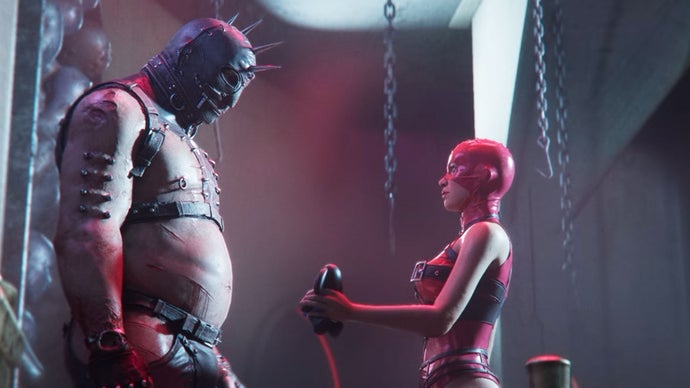
Clive Barker's Hellraiser: Revival opens with a couple exploring BDSM together. Aidan and Sunny discover a puzzle box that, when solved, summons torture demons called Cenobites. Sunny is killed in the process, and Aidan must bargain with one of the demons to bring her back to life.
The setup immediately raises a familiar horror trope: the character who engages in non-traditional sexuality dies. In slasher films and other horror stories, particularly from the 1970s, characters often face punishment immediately after casual, unmarried, or unconventional sex. The narrative suggests cause and effect: the character explores their sexuality, then dies as retribution.
Game director Emil Esov and narrative director Antony de Fault pushed back on this interpretation during an interview at Gamescom. "She did not die as a punishment," Esov said. "There's method to what Cenobites offer and what they do, and she sort of willingly did it."
De Fault expanded on the distinction. "They're fucking around and finding out. But their finding out isn't a value judgement on our part where we're trying to say 'They did this bad thing'. It's not puritanical where this character is into BDSM and so therefore must die."
Instead, the developers frame Sunny's death as a consequence of a deeper character trait she and Aidan share: an impulse toward self-destruction. "They simply pursue their own annihilation because that's the type of people they are," de Fault explained. Esov added that both characters "come from this place of seeking something more to fill their inner voids. They have a troubled relationship. Their sex play is probably the result of their past behaviours and past lives."
The game includes interactive BDSM sequences with other characters that de Fault described as "healthy and fine." Those characters, he said, are "pretty self-assured." The distinction matters: the developers are careful to separate unhealthy self-destructive behavior from BDSM itself.
"We didn't want to demonise fetish or BDSM," de Fault said. "What is depicted as 'bad' in the game are unhealthy ways of engaging with BDSM, not fetish or BDSM themselves."
This approach traces back to Clive Barker's 1986 short story The Hellbound Heart, which inspired the Hellraiser films. De Fault explained that Barker drew from his own experiences as a gay man in BDSM clubs in 1980s New York. "He certainly wasn't judging people for engaging in that behaviour, but he was pointing at the dangers of excess and irresponsible engagement with that. That was an important line for us to tow."
The historical context matters. When Barker wrote The Hellbound Heart, the AIDS crisis was emerging and marginalized communities faced blame for the disease. Writing four decades later, the developers cannot access that same anxiety, but they argue the core themes remain relevant. "It's all about this endless pursuit of filling voids through BDSM, or body transformation, the sense of identity that brings," Esov said. "They're still as relevant now as they were back then."
Esov, who grew up in the Balkans in a patriarchal society, said working on the project with de Fault, who grew up in a more liberal environment, shifted his perspective on how they depict bodies and sexuality. The team made a deliberate choice to show male and female bodies, pain, and pleasure with equal weight.
"We show female pain, male pain, female pleasure, male pleasure," de Fault said. "We linger on female bodies and male bodies as equally as we could in the game." The demo includes scenes where Sunny dominates Aidan, piercing his nipple for sexual pain, as well as full-frontal male nudity alongside female nudity. Other scenes reverse their roles.
De Fault also noted that the team had to expand their approach to BDSM and fetish content because cultural attitudes have shifted since the 1980s. "This is being made after 50 Shades of Grey, after the mainstreaming of Pride and queer culture which overlaps fetish culture and neurodivergent culture," he said. He hinted at content in the game that he considered "too spicy" to discuss in the interview, preferring to "let the game speak for itself."
Hellraiser: Revival is scheduled for release in October.
Sources
- Rock Paper ShotgunEstablished publication · recorded Sep 28, 2026"We didn't want to demonise fetish or BDSM": People aren't dying in horror game Clive Barker's Hellraiser: Revival because of what they do in the bedroom