
Dune Awakening's creative director on working with Hollywood, monetisation models, and why style matters
As Dune Awakening expands to consoles, Funcom's chief creative officer Joel Bylos discusses how the studio navigates approval from Legendary Pictures, why the game skipped photorealism, and what monetisation strategies might come next for the live-service

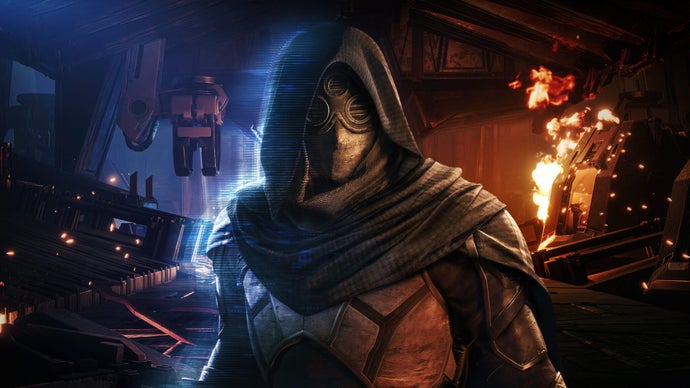
Dune Awakening is heading to consoles, and with it comes a substantial update that adds single-player mode and adjustable difficulty options to Funcom's multiplayer survival game. To discuss the expansion and the studio's creative direction, we spoke with Joel Bylos, chief creative officer at Funcom, who reflected on the challenges and opportunities of developing a game based on a major film property.
Working with a Hollywood studio means navigating approval processes that sound mundane but signal a healthy relationship. Bylos explains that Funcom submits creative decisions to Legendary Pictures, the company behind the Dune films, through project-management software Jira. "We submit things to Jira, they approve within a certain amount of time," he says. "If they don't approve within a certain amount of time, we escalate to them: 'Hey, we need you to approve this'. Usually it's a pretty automated process. It runs pretty solidly."
The approval chain can extend further when necessary. Legendary decides whether to escalate requests to Frank Herbert's estate or to director Denis Villeneuve. Bylos notes that Villeneuve offered one piece of feedback: the game's title "could be a little too close to Star Wars" – referring to The Force Awakens – but Dune Awakening ultimately kept its name.
Building trust with the film studio has been key to streamlining collaboration. "When you've established that trust, the processes aren't necessarily as important: it's more about just knowing that the other people have the IP's back," Bylos explains. This reflects a broader shift in how game and film companies work together, moving away from the lax oversight that characterised licensed games in previous decades.
The creative decision to pursue style over photorealism shaped how Dune Awakening looks and plays. Bylos emphasises that this choice extended to how the studio optimises for different hardware. "You optimise the hell out of a game for a console," he says. "The consoles have different requirements, but there's something nice about having a reliable piece of hardware that doesn't change." The PlayStation 5 version takes advantage of the DualSense controller's haptic feedback and adaptive triggers, with the sandworm and sand walking mechanics benefiting from the added vibration detail.
The console launch represents a significant moment for player growth. "We're hoping for a whole surge of players," Bylos says. Funcom has focused on retention strategies, including more in-game events and longer play sessions. The studio is also considering how monetisation might evolve.
Currently, Dune Awakening operates as a premium title with paid DLC. Bylos notes that Funcom has experimented with different models across its portfolio. Conan Exiles, for example, has shifted through multiple approaches: starting with a battle pass store model, then removing the battle pass while keeping the store. "I assume Dune will follow a similar thing," he says. "We will see the trends, and we'll see what's happening, and then we'll see what makes sense for us."
He acknowledges that live-service monetisation remains unpredictable. "The business models have upgraded and changed so much, and you never know what the next one's going to be," Bylos says. "It's now kind of a mess and they're all different." He references the industry's shift from MMO subscriptions to free-to-play models with monetisation, citing Guild Wars 2 as a pioneer of the pay-once approach.
Recent industry discussions around in-game advertising have caught Bylos's attention. Funcom has no plans to introduce advertising in Dune Awakening, but he points out that the studio actually pioneered this model years ago. "It's funny because people don't know that we pioneered that in Anarchy Online, our old game from 2001," he says. "And it made sense: it was a sci-fi, futuristic city, and we had banners in the game that were paid advertising from companies outside the game. We got decent money for that, and it didn't really impact player experience."
Funcom announced layoffs in late 2025 to focus on releasing content for Dune Awakening, and subsequently closed The Outsiders, the studio behind Metal: Hellsinger. The majority of Funcom's resources are now directed toward Dune Awakening, though the studio maintains a small team supporting Conan Exiles. The enhanced edition of Conan Exiles released earlier in the year. Beyond that, Bylos says future projects remain in early conceptual stages. "There's a very few people like me whose job is to think about the future, so I'm also looking at what's next after Dune," he explains. "But yeah, the majority of people are on Dune Awakening, and that's kind of the way it will stay, I'd say, for quite a while."
Sources
- GamesIndustry.bizEstablished publication · recorded Sep 30, 2026Dune Awakening's creative director on copying Hollywood, in-game advertising, and why style beats photorealism