
Cherry Xtrfy K63W brings ultra-wideband wireless to gaming keyboards
The Cherry Xtrfy K63W is the first consumer gaming keyboard to use ultra-wideband (UWB) wireless technology, offering 8K polling rates and up to 1100 hours of battery life. The compact 70 percent keyboard features low-profile mechanical switches and costs

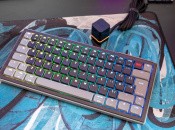
Cherry Xtrfy has released the K63W, marking the first consumer gaming keyboard to adopt ultra-wideband (UWB) wireless technology instead of the standard 2.4GHz connectivity found on most wireless peripherals.
UWB operates on higher and wider frequencies in less congested parts of the electromagnetic spectrum, with the theory being that these more advanced transmitters and receivers perform more reliably, especially at higher polling rates. The K63W features an 8K polling rate, making it more responsive than the vast majority of wireless keyboards on the market.
The keyboard is built around pre-lubricated and gasket-mounted MX Low Profile 2.0 linear switches that are quiet yet satisfying. Its compact 70 percent form factor makes it portable, while a 6000mAh battery delivers up to 1100 hours of battery life when lighting is disabled at 1000Hz. At maximum polling rate, the keyboard still offers roughly a week of use between charges. Recharging happens via USB-C.
According to Digital Foundry's review, the UWB implementation provides excellent connectivity even in environments with heavy 2.4GHz activity, such as LAN parties, where traditional wireless keyboards might struggle. The short-throw switches and SOCD function tested well in competitive titles like Overwatch 2 and Valorant. Battery life benefits from the wideband transmissions, which are theoretically briefer than 2.4GHz alternatives.
The keyboard lacks Bluetooth support, which is a notable omission given its portability and compact design. Instead, users must rely on the included cube-shaped dongle or a wired connection via USB-C. This aligns with the direction taken by other high-end wireless peripherals like the Razer Viper V4 Pro.
The typing experience stands out for a mechanical design at this size. The low-profile switches deliver smooth presses thanks to the gasket mount, and the keyboard produces a surprisingly deep sound signature for its form factor, remaining quiet enough for use in crowded spaces. The layout includes an F-key row for content creation alongside gaming, and four keys in the lower right serve dual purpose as both modifiers and arrow keys through a mod-tap function, allowing quick text navigation.
The ABS keycaps are noted as somewhat slick and may wear faster than PBT alternatives, though they remain functional. The keyboard supports both UK/ISO and US/ANSI layouts and can toggle between macOS and Windows layouts via shortcut.
Software functionality covers the basics but lacks a web version, which has become increasingly common among gaming keyboard manufacturers. The software is more polished than Cherry's previous K5 Pro implementation.
At £155/$180, the K63W positions itself at the premium end of the gaming keyboard market. Whether UWB technology justifies the price remains unclear without widespread evidence that it improves actual gameplay performance.
Sources
- Digital FoundryEstablished publication · recorded Sep 25, 2026Review: Cherry Xtrfy K63W: Ultra-Wideband Wireless Tech Comes to Gaming Keyboards