
AMD Cuts Ray Tracing Memory Usage by 98% for Dense Forest Scenes
AMD researchers have demonstrated a new tetrahedral cage technique that reduces GPU memory demands for rendering heavily animated plants and foliage, slashing requirements from 80 GB to 1.7 GB.

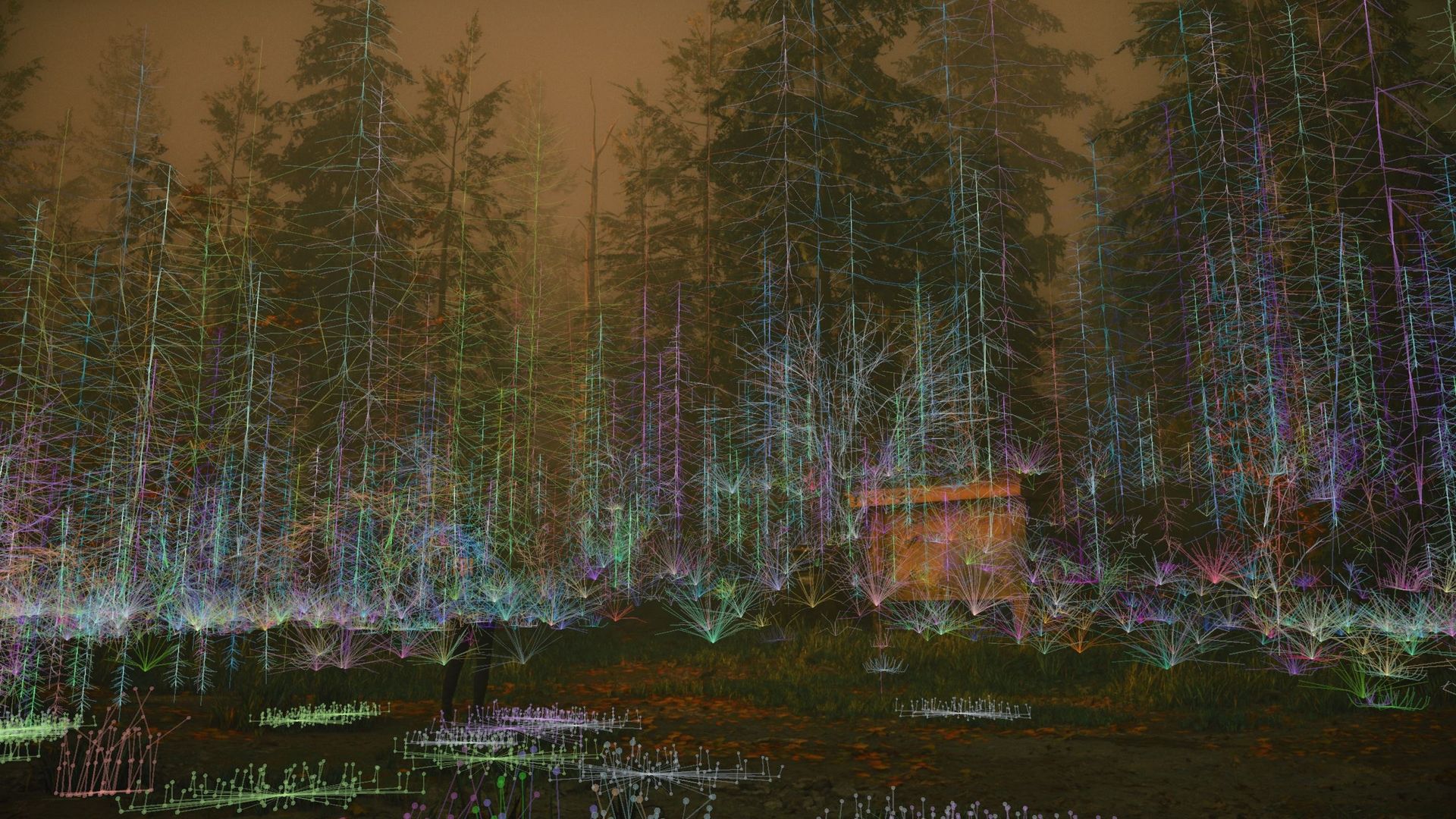
AMD has unveiled a new approach to ray tracing dense vegetation that dramatically reduces memory requirements and processing time. Researchers at the company have developed a tetrahedral cage technique capable of cutting ray tracing memory usage by 98% for scenes containing thousands of animated plants.
In traditional rendering, a scene with around 25,000 independently animated plants made of hundreds of thousands of triangles could consume 80 GB of GPU memory. Processing such a scene on an AMD Radeon RX 9070 XT would take approximately 300 ms per frame just to determine which surfaces intersect with rays, resulting in slow, choppy performance.
The tetrahedral cage approach wraps a simplified mesh around dense plant geometry. Rather than ray tracing individual leaves and branches, the technique traces rays against the simplified cage structure instead. During runtime, only the cage deforms to match animation, while the underlying dense geometry and its data structures remain static and reusable. This allows rays to be transformed back into a static reference frame before intersecting with the full triangle set.
Holger Gruen, a Fellow of AMD's Advanced Graphics Program, explained the method on GPUOpen: "The dense geometry of an animated object and its BVH structures remain static and reusable. During runtime, only the cage deforms. Rays are transformed back into a static reference frame before intersecting them with the dense set of triangles."
The technique delivers dramatic performance gains. AMD's tetrahedral cage demonstration uses only 1.7 GB of memory and approximately 3.3 ms for all updates per frame, compared to the traditional approach's 80 GB and 300 ms.
The trade-off involves reduced control over individual vertex animation. Developers cannot fine-tune every leaf or branch movement, making the technique most suitable for distant foliage and field-wide scenes rather than close-up views of individual plants with fine detail.
The technology remains a research demonstration rather than a shipping feature. AMD is developing DXR samples and a header-only C++ library to help developers build high-quality tetrahedral cages for various animation types. More details are available in the open access paper 'Ray Tracing Massive Amounts of Animated Geometry'.
Sources
- PC GamerEstablished publication · recorded Sep 21, 2026Touch grass? Not when AMD has whittled down ray tracing memory usage by 98% for these hardware-sapping bushes and trees