
Three 4X Games, Three Solutions to Exploration's Disappearing Act
Amplitude Studios, Firaxis, and other developers tackle a persistent problem in strategy games: how to keep exploration and strategic discovery engaging throughout long campaigns.

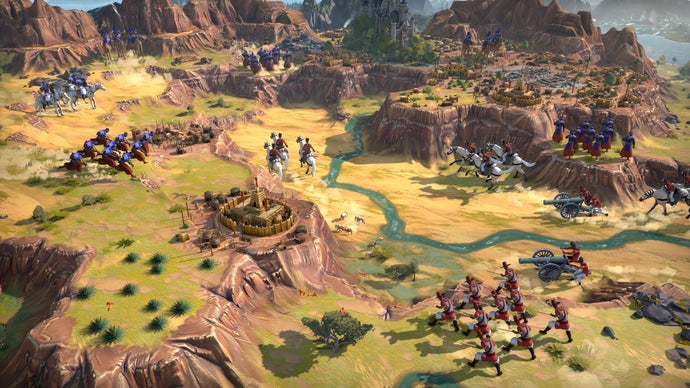
The "explore" phase of 4X strategy games has a shelf life. Once you've uncovered the map and assessed your resources and opponents, your strategy crystallizes. You see what you have, you see what you're facing, and you commit to a plan. Few reasons remain to change course. For Amplitude Studios' co-founder and CEO Romain de Waubert de Genlis, this is an "inherent problem" his team has worked to solve since the first Endless Legend in 2014.
"One of the X's, 'explore', disappears after a while," de Waubert de Genlis explains. The discovery doesn't stop at the map alone. Players also lock in their long-term strategy early, leaving campaigns feeling static and repetitive by the mid-game.
Endless Legend 2 takes a dramatic approach. Campaigns begin with players scattered across islands surrounded by high seas. As turns pass, the water recedes and reveals new territory to claim. By introducing fresh land halfway through a game, players cannot plan their entire strategy in the opening turns. "It shuffles the cards again and again," de Waubert de Genlis says. The new terrain also comes with choke points around valuable resources, forcing conflict and creating the feeling that "I have to fight for that little piece of new land that just appeared."
Amplitude also addressed a related problem: many players restart games repeatedly if their starting area doesn't suit their strategy, rather than adapting to what they're given. Stats suggest full playthroughs account for only about 5% of games started. To discourage endless rerolling, Amplitude guarantees balanced starter areas with good resources but never an overwhelming number. The goal is to convince players that imperfect starts are manageable.
Firaxis tackled the same challenge differently for Civilization 7. Creative director Ed Beach noted that "it's tough to get through the whole game," as the number of units and entities to manage explodes mid-campaign. The solution: break campaigns into chapters. Players advance through historical eras until hitting a crisis point that marks a chapter's end. Progressing into the next chapter unlocks new technologies and sets a different crisis to survive. Executive producer Dennis Shirk explained that this approach mirrors Amplitude's philosophy: "Chapters are Firaxis's way of saying 'wait, we've got something cool that you could try first.'"
However, Civilization 7 introduced an unpopular system: players selected a new successor civilization when entering each chapter. Swapping nations made players feel unconnected to their final faction, as though they weren't playing the nation they started with. Firaxis has spent two years walking back these systems, now allowing players to carry a single nation from campaign start to finish.
Amplitude's upcoming strategy game Humankind 2 faces similar challenges. Like Civilization, players pick a historical nation and advance through eras, adopting different cultures at key points. But Humankind 2 game director Benoit Humbert is confident the game won't repeat Civilization 7's reception because his team has already learned the lesson. "Players of Humankind told us that they had the feeling that they were switching from one culture to another and didn't have the feeling that they were playing something evolving through time, so we changed that for Humankind 2."
Instead of selecting a new nation, players now advance using a system Humbert describes as "more like an RPG." When entering a new age, players select cultural traits as skills from a skill tree. The core aim is making players feel they're evolving a single nation across time, not abandoning one culture for another. "You don't leave something behind," Humbert says.
These approaches all address the same core issue. De Waubert de Genlis reflects on Amplitude's evolution: "On the first Endless games we made, the main focus was to make a good solid classic 4X. But of course we were not fixing that inherent problem you have of that mid to end game, which could be a bit flat, repetitive, not as exciting. So since Endless Space all our focus is on how we can renew that pleasure and keep the player excited until the last minute."
Sources
- Rock Paper ShotgunEstablished publication · recorded Sep 18, 2026Three different 4X strategy games, three different solutions to "that inherent problem" of disappearing exploration