
AI and Player Intelligence Reshape Mobile Game Marketing in 2026
Mobile game advertising is accelerating with AI-driven creative production and behavioral insights. Global advertisers grew 31% year-over-year in H1 2026, but AI adoption still faces a maturity gap between usage and measurable returns.

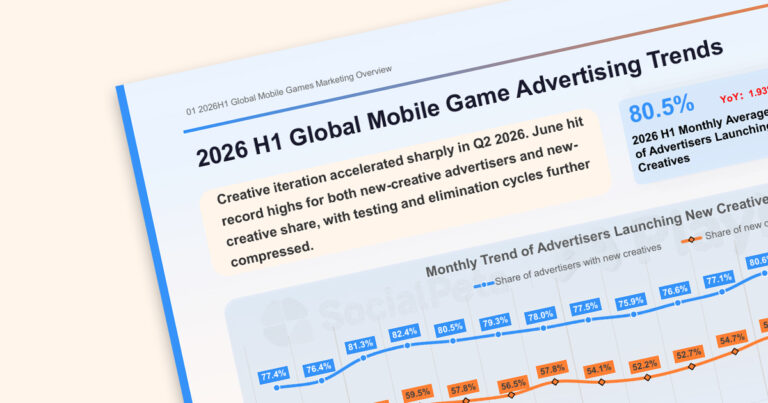
Mobile game marketing entered a new phase in 2026, driven by faster creative iteration, widespread AI adoption, and a sharper focus on player quality metrics. A report published by SocialPeta, Playio, and Funtap Games examined these shifts across the first half of the year, revealing how the industry is restructuring its approach to acquisition and creative testing.
The advertising landscape itself expanded significantly. Global mobile games averaged 109,500 active advertisers per month in H1 2026, up 31.1% year-over-year and 10.7% quarter-over-quarter. Approximately 13,500 new advertisers entered the market each month, though new-advertiser growth concentrated in Q1. By Q2, focus shifted toward existing advertisers increasing investment and accelerating creative output.
Advertiser behavior reflected this acceleration. An average of 80.5% of advertisers launched new creatives each month, with new creatives representing 55.7% of monthly creative volume. Both figures reached 18-month highs in June. Geographic patterns showed Europe with the largest advertiser base at 60,400 per month, while North America recorded the highest creative intensity at 112 monthly creatives per advertiser on average. Competition varied by genre. Casino and casual games relied on advertiser scale, while tabletop and strategy titles competed through heavier creative investment. Tabletop games averaged 370 creatives per title and strategy games 305. Leading advertisers included Oakever Games titles such as Tile Explorer, Vita Mahjong, and Zen Word, alongside Block Blast!, MONOPOLY GO!, and Dark War: Survival.
AI adoption became nearly universal, yet its business impact remained uneven. The report found that 49% of projects use AI in creative production, but only 30% achieved measurable ROI growth, revealing a 19-percentage-point maturity gap. AI simplifies producing creative assets at scale, but higher output does not automatically translate into better campaign performance. Funtap Games estimated that around 97% of creative hypotheses fail to become scalable winners.
Rather than predicting winning creatives in advance, AI helps teams test more ideas, eliminate weak directions faster, and validate concepts through market response. Funtap's approach covers four stages: market insights and hypothesis development, rapid AI-assisted conceptualization, creative production and variation, and data-driven analysis and scaling. The process was applied to titles including Tân 3Q MAX, Infinity Kingdom, and Dark War: Survival. Funtap's conclusion remained direct: AI does not replace creative teams but enables smaller teams to produce, test, and iterate at greater scale.
Beyond creative output, advertisers increasingly focused on player quality after acquisition. Playio used a rewarded gameplay ecosystem to observe post-install behavior, including playtime, retention, level progress, engagement, and cross-genre preferences. These first-party behavioral signals helped advertisers evaluate whether users would sustain play and generate long-term value. Internal data from Q1 2026 for Korean Android users recorded 86 minutes of average daily playtime, more than 60 minutes across every measured genre, and more than 90 minutes for RPG, strategy, and racing games. Users averaged 3.6 games played per day, with 66.7% exploring genres beyond their primary preference.
Playio's STORM engine applied AI to 90-day gameplay data, using visual and linguistic analysis to identify player intent, engagement patterns, and value potential beyond basic demographics. In one internal campaign example, STORM increased daily installs by 200% while return-on-ad-spend rose from 330% to 724%, a gain of 394 percentage points. The report noted these results reflected a specific campaign, not a universal benchmark.
AI increasingly became a structural element of creative assets themselves. Leading games used AI-generated content as an attention layer before transitioning to real gameplay. One high-performing creative opened with an AI-generated cinematic of an elderly man cornered by a giant rat, then moved into tower defense, shelter management, and resource collection messaging. It generated an estimated 95,000 impressions over 12 days. A Japan-focused creative used warm, watercolor-style AI illustrations for approximately 25 seconds before revealing the game's 3D gameplay in the final three seconds, generating an estimated 200,000 impressions and a SocialPeta popularity score of 134 over 27 days. An AI-generated 3D warrior and full-screen attacks opened another creative before shifting into progression, hero merging, and combat footage, generating an estimated 220,000 impressions over 19 days. Across examples, AI attracted attention while gameplay footage explained the product and managed player expectations.
The report identified batch generation, cross-style art adaptation, intelligent localization, and dynamic or interactive content as four major AI applications in mobile game advertising. It also highlighted five challenges: copyright and compliance, creative homogenization, inconsistent art quality, character authenticity, and platform review risks. Over the next one to two years, AI creative workflows are expected to evolve toward a connected process covering insight, generation, testing, optimization, and attribution. AI may not remove uncertainty from mobile game marketing, but it is giving teams a faster and more structured way to learn from it.
Sources
- Game World ObserverEstablished publication · recorded Sep 18, 2026AI, Creative Velocity, and Player Intelligence Are Reshaping Mobile Game Marketing