
Meta builds 1GW AI data center in Ohio, plans 5GW Louisiana facility
Meta's infrastructure chief described the company's massive Prometheus supercluster in Ohio and outlined plans for an even larger facility in Louisiana designed to support next-generation AI model training.

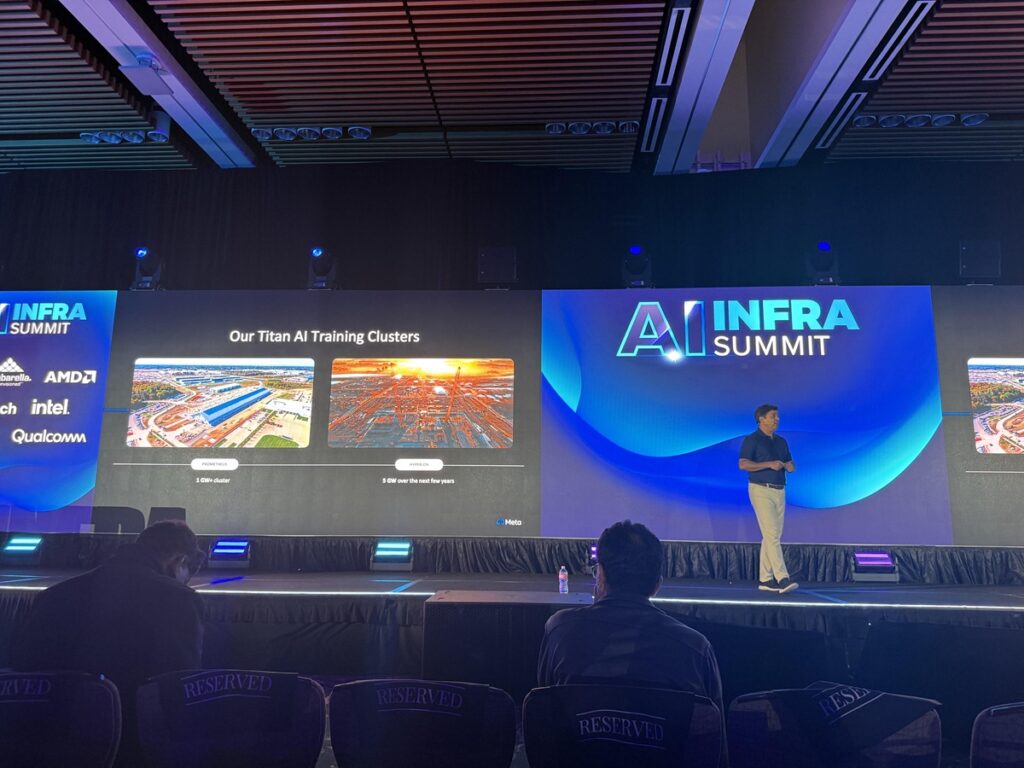
Meta is building data centers at unprecedented scale to support its artificial intelligence ambitions. Santosh Janardhan, Meta's Head of Infrastructure, detailed the company's approach at the recent AI Infra Summit, describing how Prometheus, a one-gigawatt-scale AI supercluster in New Albany, Ohio, was designed and operated.
Prometheus spans thousands of acres across 30 to 40 buildings and contains hundreds of thousands of graphics processing units (GPUs). The facility serves as the foundation for Meta's Superintelligence Labs effort to train and deploy next-generation large language models. Meta is now applying lessons from Prometheus to plan Hyperion, a five-gigawatt facility in Richland Parish, Louisiana that Janardhan described as "Manhattan-sized."
Designing a data center of this magnitude required rethinking conventional infrastructure assumptions. Janardhan said the first major challenge was the assumption that an AI training cluster must exist under one roof. Instead, Prometheus comprises distributed buildings separated by three to five kilometers. At this scale, distance creates latency issues governed by physics: roughly five microseconds per kilometer. For AI training clusters with over 100,000 GPUs, latency becomes critical because network throughput is limited by the slowest connection.
Meta addressed this by building a custom network layer called the backend aggregation network, designed as an "Ethernet super spine." The system includes multiple spines connecting buildings within the facility and aggregates subspines across the three to five kilometer radius. Network wiring operates at tens of petabytes per second, sufficient to transmit the Library of Congress in under 30 seconds. The redundant design eliminates single points of failure and allows the system to handle packet loss locally.
Another critical requirement for AI training is lossless data transmission. Unlike the internet, which tolerates data loss, AI training cannot afford it. Meta's network architecture concentrates and resolves packet loss at the local backend layer.
To accelerate construction, Meta deployed data-center-scale tents measuring roughly two to two-and-a-half football fields, each providing 30 megawatts of capacity and built to withstand level-one hurricanes. This approach reduced deployment time by 70 to 80 percent, shifting construction from years to months.
Managing failures at this scale required innovation. Early Prometheus deployments experienced interruptions from network changes, cooling issues, hardware failures, and construction variables like concrete dust affecting fiber links. Meta reduced interruptions by a factor of 50, targeting no more than two interruptions per 8,000 GPUs per day. The company implemented parallelism-aware fault tolerance (PAF), which uses model parallelism, data layout, physical topology, availability, cost, and latency to route around failures and recover from continuous checkpoints.
Prometheus remains under construction while actively serving training jobs and adding GPUs. Janardhan emphasized that the ultimate measure of success is not infrastructure scale but how effectively these clusters are used. "GPU count, fiber distance, and facility size are ultimately vanity metrics unless they improve user and business outcomes," he said.
Sources
- GamesBeatEstablished publication · recorded Sep 24, 2026How Meta built a 1GW data center in Ohio and is planning for a 5GW data center in Louisiana